
Your Garage Door Is More Powerful Than You Think
Most homeowners in Chelsea don't give their garage door a second thought. You press a button, it goes up. You press it again, it comes down. Simple, right?
But here's something worth considering: your garage door is the single largest moving object in your home. A standard two-car garage door can weigh anywhere from 150 to over 400 pounds. That's a lot of force moving up and down multiple times a day — and if the built-in safety features aren't functioning correctly, it can pose a serious risk to your family, your pets, and your property.
The good news is that modern garage doors come equipped with several important safety mechanisms. Understanding how they work — and knowing when they need attention — can prevent accidents and give you real peace of mind.
The Auto-Reverse Mechanism
Federal law has required garage door openers to include an auto-reverse feature since 1993. This mechanism is designed to detect resistance when the door is closing and immediately reverse direction. If your garage door contacts an object — a bicycle, a trash can, or anything else in its path — it should stop and go back up.
There are two main types of auto-reverse systems:
- Mechanical auto-reverse: The door reverses when it physically contacts an object. The opener senses the resistance and triggers the reversal.
- Photoelectric auto-reverse: This uses safety sensors (more on those below) to detect objects in the door's path before contact is made.
You can test your mechanical auto-reverse at home. Place a 2x4 flat on the ground in the center of the doorway, then close the door using the opener. When the door touches the board, it should reverse within two seconds. If it doesn't, your opener needs immediate attention.
Photoelectric Safety Sensors
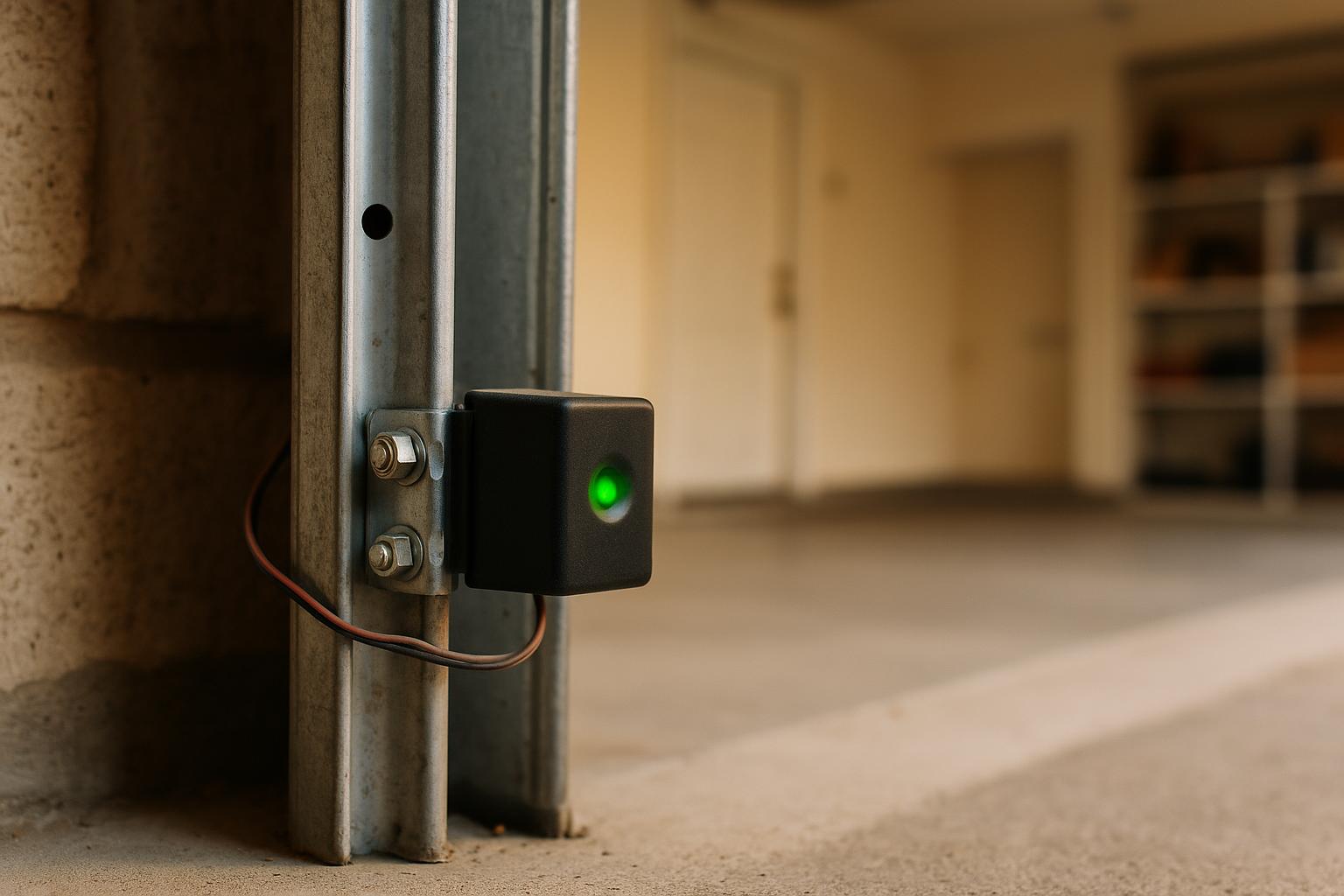
If you look at the bottom of your garage door tracks — about six inches off the ground — you'll see two small devices facing each other on opposite sides. These are your photoelectric safety sensors, and they're one of the most important safety features on your garage door.
These sensors project an invisible infrared beam across the doorway. If anything breaks that beam while the door is closing, the door will stop and reverse. This is especially critical for families with young children or pets who might dart under a closing door.
Common Problems With Safety Sensors
Safety sensors are reliable, but they can run into issues:
- Misalignment: If one sensor gets bumped or shifts, the beam won't connect and the door may refuse to close. You'll usually see a blinking light on one or both sensors.
- Dirty lenses: Dust, cobwebs, and grime can block the sensor's beam. A quick wipe with a soft cloth often solves the problem.
- Sun interference: Direct sunlight hitting a sensor can overwhelm the infrared signal. This is a common complaint during summer evenings here in Chelsea when the sun sits low on the horizon.
- Wiring damage: The thin wires connecting sensors to the opener can get snagged, chewed by rodents, or damaged over time.
If your garage door closes fine using the wall button (when you hold it down) but won't close with the remote, your safety sensors are almost certainly the issue. The wall button overrides the sensors as a manual safety feature, but this isn't a long-term solution — it's a sign that something needs to be fixed.
The Emergency Release Handle
That red rope hanging from your garage door opener track isn't decoration. It's the emergency release handle, and every member of your household should know how to use it.
Pulling the emergency release disconnects the door from the opener, allowing you to operate the door manually. This is essential in two situations:
- Power outages: When the power goes out — something that happens more than a few times a year in the Chelsea and Dexter area — the emergency release lets you open or close your garage door by hand.
- Opener malfunctions: If your opener fails or the door gets stuck, the emergency release lets you safely move the door without forcing the motor.
A Word of Caution
Never pull the emergency release when the door is partially open unless you're certain the springs are in good working condition. If a spring is broken, the full weight of the door could come crashing down. When in doubt, call a professional.
The Manual Lock
Many garage doors — especially older ones common in homes throughout Manchester, Stockbridge, and the surrounding communities — still have a manual slide lock on the inside. This lock secures the door by sliding a bar into the track.
Here's the important thing: if the manual lock is engaged when you try to operate the door with an electric opener, it can cause serious damage. The opener will try to lift the door while the lock holds it in place, potentially stripping gears, bending tracks, or burning out the motor.
If you have an automatic opener, it's a good idea to either disable the manual lock entirely or make sure everyone in the household knows not to engage it. Many homeowners in the Chelsea area don't even realize their door has one until something goes wrong.
Rolling Code Technology
If your garage door opener was manufactured in the last 15 to 20 years, it likely uses rolling code technology. Each time you press your remote, the opener generates a new, random code. This prevents someone from using a code-grabbing device to copy your signal and open your garage door.
Older openers that use fixed codes are more vulnerable to this type of security breach. If your opener is from the 1990s or earlier, upgrading to a modern unit with rolling code technology is a smart investment in your home's security — especially since your garage often provides direct access to your house.
Tamper-Resistant Brackets
The bottom brackets on your garage door — the ones that connect the lifting cables to the bottom of the door — are under extreme tension. These brackets are sometimes called "tamper-resistant" because they're designed to discourage homeowners from trying to adjust or remove them.
This is not a DIY job. The cables attached to these brackets are connected to the spring system, and they carry enough force to cause severe injury. If you notice a frayed cable or a loose bottom bracket, call a professional garage door technician right away.
Simple Safety Checks You Can Do Today
You don't need any special tools or expertise to perform a basic garage door safety check. Here's a quick list you can run through this weekend:
- Test the auto-reverse: Use the 2x4 test described above.
- Check the sensors: Wave a broom handle through the sensor beam while the door is closing. It should reverse immediately.
- Inspect the emergency release: Pull it to make sure it disengages smoothly, then re-engage it.
- Look at the cables and springs: Visually inspect for fraying, rust, or gaps. Don't touch — just look.
- Listen: Run the door through a full cycle. Grinding, scraping, or popping sounds can indicate a problem.
If anything seems off during these checks, don't ignore it. A small issue today can turn into a dangerous — and expensive — problem tomorrow.
When to Call a Professional
Some garage door safety issues are easy to handle on your own. Cleaning a sensor lens or testing the auto-reverse takes just a few minutes. But anything involving springs, cables, brackets, or opener wiring should be left to a trained technician.
At Chelsea Garage Door, we help homeowners throughout Chelsea, Dexter, Saline, Grass Lake, and the surrounding communities keep their garage doors safe and reliable. Whether you need a quick safety inspection, a sensor repair, or a full opener upgrade, we're here to help — and we treat every job like it matters, because it does.
If it's been a while since anyone looked at your garage door's safety features, give us a call. A little attention now can prevent a lot of trouble later.